
The Art of Modern Elegance: Glass-Fronted Cabinet Redefines Luxury Kitchen Design
- seo
- 2025-12-17
- 195
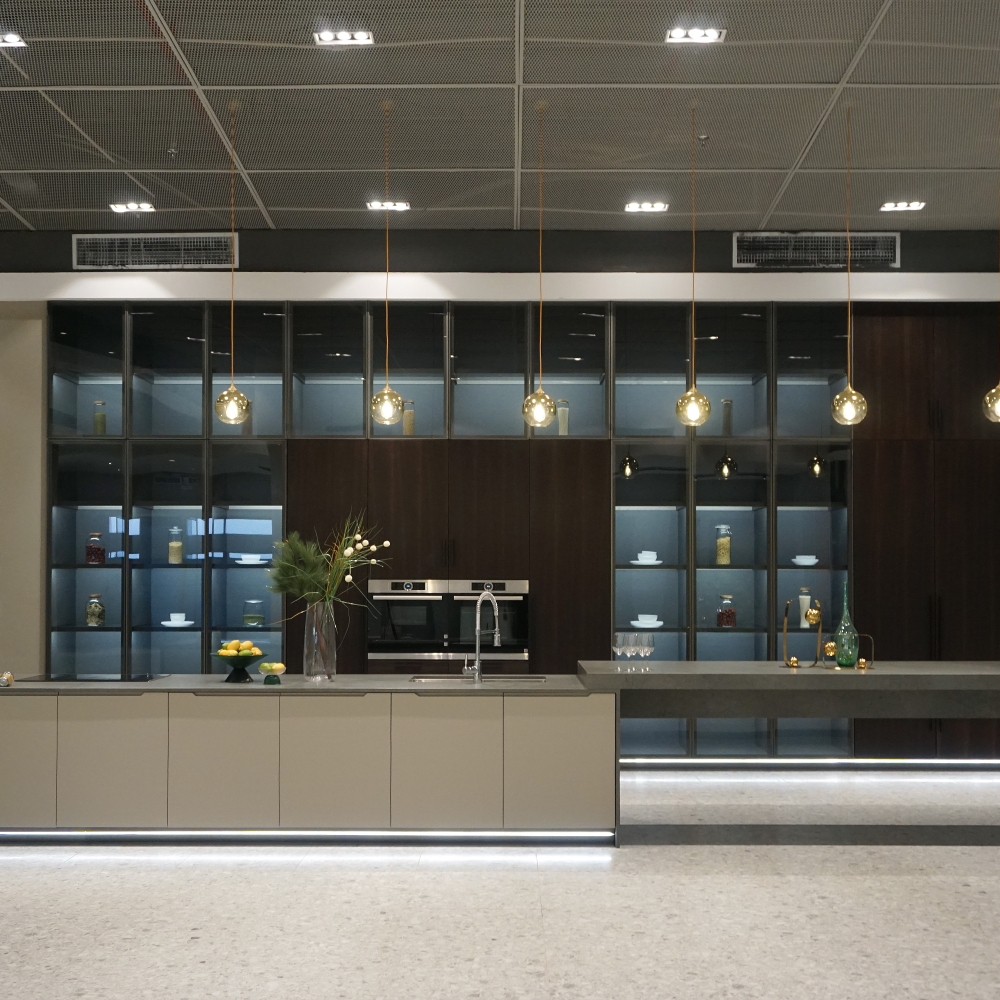
In the ever-evolving world of interior design, certain elements rise above mere functionality to become true statements of style, sophistication, and spatial mastery. Among these, the tall cabinet—particularly one with a sleek, glass-fronted facade—is emerging as the crown jewel of contemporary kitchens. The image before us captures not just a piece of furniture, but a vision: a towering, dark-wood cabinet system that blends minimalist architecture with luxurious detailing, transforming an ordinary kitchen into a gallery of modern living. This isn’t merely storage—it’s sculpture. It’s not just cabinetry—it’s ambiance. And it’s not simply a backdrop—it’s the focal point of a meticulously curated environment where light, texture, and form converge in perfect harmony.
The Grandeur of Vertical Space
What immediately commands attention is the sheer verticality of this cabinet structure. Rising from floor to ceiling, it dominates the wall without overwhelming the space. Its height creates a sense of grandeur, drawing the eye upward and elongating the room—a clever trick often employed in high-end showrooms and luxury residences to create an illusion of expansiveness.
But this isn’t about scale alone. The cabinet’s proportions are carefully considered: its width is generous enough to accommodate substantial storage, yet restrained enough to avoid visual clutter. The result? A commanding presence that feels intentional, balanced, and utterly refined.
The choice of dark wood veneer for the solid panels adds warmth and richness to the composition. Unlike stark black lacquers or cold metallics, this deep brown finish invites touch and evokes tradition—even as the overall design screams modernity. It’s a nod to classic craftsmanship, reimagined through a contemporary lens.
Perhaps the most striking feature is the extensive use of glass-fronted compartments. These aren’t your grandmother’s china cabinets. Instead, they’re precision-engineered display cases, framed in slim, matte-black metal profiles that recede into the background, allowing the contents—and the lighting—to take center stage.
Each glass panel acts like a window into a curated collection: gleaming porcelain bowls, artisanal glassware, decorative jars filled with grains or spices, and sculptural vases. The transparency invites curiosity, turning everyday objects into art pieces. It also reflects light beautifully, multiplying the glow from the pendant lamps above and the LED strips below, creating a luminous, almost ethereal effect.
But there’s more to these glass fronts than aesthetics. They serve a practical purpose too: visibility. In a busy household, being able to see what’s inside without opening doors saves time and reduces clutter. It encourages organization—not because you have to, but because you want to. After all, when your pantry doubles as a display case, you’ll naturally keep it neat and beautiful.
Lighting: The Secret Ingredient
No discussion of this cabinet would be complete without addressing the role of lighting. Here, illumination isn’t an afterthought—it’s integral to the design narrative.
Above, a series of golden globe pendants hang at staggered heights, casting warm pools of light that dance across the countertop and reflect off the glass surfaces. Their brass-toned cords and spherical shapes add a touch of retro glamour, contrasting beautifully with the clean lines of the cabinetry.
Below, continuous LED strips run along the base of the island and the lower edge of the cabinet, bathing the floor in a soft, ambient glow. This subtle under-lighting not only enhances safety (no more tripping over furniture in the dark) but also adds depth and dimension to the space. It makes the cabinet appear to float slightly above the ground, enhancing its sculptural quality.
Inside each glass compartment, recessed spotlights highlight individual items, creating mini vignettes that draw the eye inward. This layered approach to lighting—overhead, under-cabinet, and internal—is a hallmark of high-end design, transforming the kitchen from a utilitarian zone into a dynamic, mood-setting environment.
Integration with the Surrounding Environment
One of the most impressive aspects of this cabinet is how seamlessly it integrates with the rest of the kitchen. Rather than standing apart as a separate unit, it flows into the architecture of the room.
The countertop material—a textured, concrete-like surface—extends uninterrupted from the island to the cabinet base, creating visual continuity. The same goes for the flooring: speckled terrazzo tiles provide a neutral canvas that allows the darker tones of the cabinetry to stand out without clashing.
Even the ceiling contributes to the cohesive aesthetic. Exposed grid panels and recessed downlights echo the industrial-chic vibe of the pendant lights, while ventilation grilles are discreetly integrated into the upper trim, maintaining the clean lines of the design.
This level of integration speaks to the importance of holistic thinking in modern interiors. Every element—from the hardware on the cabinet doors to the placement of the sink faucet—is considered in relation to the whole. Nothing feels random; everything serves a purpose, both functional and aesthetic.
Function Meets Form: Storage Reimagined
Beneath the beauty lies brains. This cabinet isn’t just pretty—it’s incredibly practical. The combination of closed storage (in the solid wood sections) and open display (in the glass-fronted areas) offers flexibility for different types of items.
Imagine storing bulky appliances or rarely used cookware behind closed doors, while showcasing your favorite dinnerware or collectible bottles in the illuminated niches. The inclusion of built-in ovens within the cabinet structure further demonstrates how form follows function: no need for awkward freestanding units when you can embed them flush with the cabinetry.
The handles—or rather, the lack thereof—are another thoughtful detail. Sleek, recessed pulls or push-to-open mechanisms maintain the smooth, uninterrupted surfaces, reinforcing the minimalist ethos. It’s a design that prioritizes user experience: intuitive, uncluttered, and effortless.
A Lifestyle Choice, Not Just a Design Trend
Ultimately, this tall cabinet represents more than a trend—it embodies a lifestyle. It appeals to those who value order, beauty, and intentionality in their surroundings. It’s for people who see their home not just as shelter, but as an extension of their personality and taste.
It’s also reflective of a broader cultural shift toward “slow living” and mindful consumption. When your kitchen becomes a place of calm and contemplation—not just chaos and convenience—you begin to appreciate the details: the way light falls on a ceramic bowl, the texture of a wooden cutting board, the quiet hum of a well-designed space.
And let’s not forget sustainability. High-quality materials like solid wood veneers and durable glass mean this cabinet will age gracefully, lasting decades rather than years. That’s not just good design—it’s responsible design.
Why This Cabinet Matters Now
In 2025, as we continue to blur the lines between work, life, and leisure within our homes, the kitchen has become the true heart of the house. It’s where meals are prepared, conversations happen, memories are made. And increasingly, it’s where we seek beauty, comfort, and inspiration.
This tall cabinet answers that call. It doesn’t just store food—it elevates the act of cooking and dining into something ceremonial. It doesn’t just hold dishes—it celebrates them. It doesn’t just fill a wall—it transforms it.
For designers, architects, and homeowners alike, it sets a new benchmark: a reminder that even the most functional spaces can be infused with poetry. That elegance doesn’t require excess—but rather, restraint, precision, and vision.
Final Thoughts: A Masterpiece in Wood, Glass, and Light
To stand before this cabinet is to witness the convergence of art and utility, tradition and innovation, simplicity and spectacle. It’s proof that great design doesn’t shout—it whispers, with confidence and grace.
Whether you’re renovating your own kitchen or simply dreaming of one, let this cabinet inspire you. Let it remind you that every inch of your space deserves consideration. That storage can be stunning. That light can be lyrical. That a cabinet can be so much more than a container—it can be a statement, a sanctuary, a masterpiece.
Because in the end, the best designs aren’t just seen—they’re felt. And this one? It resonates deeply, quietly, magnificently.
SUBSCRIBE
INQUIRY